Artificial intelligence is transforming the way businesses operate. The opportunity is real. So are the governance considerations.
At Pronetic, we help organisations adopt AI in a structured, secure and compliant way, ensuring innovation never comes at the expense of control.


AI tools are appearing in everyday workflows. Staff are experimenting. Productivity gains are clear.
But important questions remain:
AI without structure introduces risk.
AI implemented correctly strengthens operational performance.
Before investing in AI, take a closer look at where it could help your business and what you need to have in place.
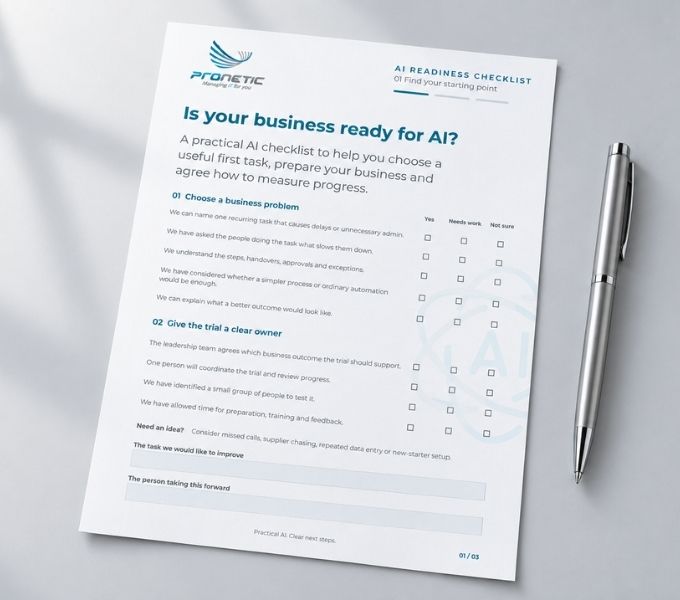
Our free AI readiness checklist helps you consider practical opportunities, data security and how prepared your team is, so you can make a more informed decision about your next step.
We understand your objectives, regulatory position and operational priorities.
We review your Microsoft 365 environment, identity controls, permissions and data structure.
We align governance, refine permissions and ensure compliance controls are in place.
We roll out AI in a controlled way and provide ongoing oversight. This ensures AI becomes an asset, not an exposure.
For organisations considering Microsoft Copilot.
We assess whether your Microsoft 365 environment is prepared for secure AI deployment.
Includes:
Outcome: A structured report with prioritised actions and clear next steps

For organisations ready to implement Microsoft Copilot.
We deliver controlled implementation and structured adoption.
Includes:
Outcome: Secure rollout with measured adoption and controlled risk
For organisations that need assurance before expanding AI usage.
We align AI implementation with your compliance framework.
Includes:
Outcome: AI embedded within your governance framework, not operating outside it.

For organisations looking to improve operational efficiency.
We design AI-enabled workflows using Microsoft automation tools.
Includes:
Outcome: Reduced manual workload, improved accuracy and measurable time savings
For compliance-driven organisations, particularly those working under ISO 27001 or Cyber Essentials Plus, we assess how AI fits within your wider risk management framework. The goal is controlled adoption, not unnecessary exposure.
We assess how your Microsoft 365 environment is configured, who has access to what, and where sensitive data may be overexposed. This gives you a clear understanding of risk before AI is introduced.
AI amplifies whatever already exists in your environment, good or bad. We identify gaps in governance, permissions, data handling and policy enforcement so you can strengthen your foundations first.
We determine whether Microsoft Copilot can be introduced safely within your organisation. That includes reviewing identity controls, MFA, data labelling, and access structures to avoid unintended data exposure.
You receive a clear, prioritised roadmap outlining what needs to be addressed, what can wait, and what is already in good shape. No technical jargon, just practical steps your leadership team can understand.
Instead of rushing into AI because competitors are doing it, you move forward based on evidence. You will know whether to proceed, pause, or strengthen your environment first, with confidence.

A business AI strategy should identify the problems you want to solve, suitable use cases, the data and tools involved, and how you will measure success. It should also establish responsibilities, security requirements, acceptable use and human oversight. Pronetic helps organisations turn these considerations into a practical plan, with clear priorities and a controlled approach to implementation.
Start by looking for repetitive, time-consuming tasks with a clear business outcome. Examples include finding internal information, preparing first drafts, summarising documents or processing routine requests. Assess how often the task occurs, how much time it takes and what could happen if the output is wrong. Pronetic helps you assess opportunities and choose a manageable starting point.
Business automation follows defined steps to complete a process, such as routing an approval request or sending a notification. AI can help interpret information, summarise text or generate a draft where the task is less rigid. The two can work together, but not every process needs AI. Pronetic helps you select an approach based on the task, its risks and the result you need.
Start by approving suitable tools, reviewing their data-handling terms and checking who can access your business information. Permissions, account security and clear rules about what employees may enter into AI tools all matter. Pronetic reviews data readiness and governance before deployment, helping reduce unnecessary exposure and establish appropriate oversight. Sensitive or consequential outputs should be checked by a responsible person.
An AI usage policy is advisable if employees use AI tools for work, including tools they have started using independently. It should explain which tools are approved, what information can be entered, when outputs need checking and who employees should contact with concerns. Pronetic can help develop practical guidance that fits your existing security policies and business processes.
Measure the process before introducing the technology, then compare results during a controlled pilot. Useful measures include time spent per task, turnaround times, error rates, staff adoption and the amount of checking or rework needed. Include licensing, implementation and training costs in the assessment. Pronetic helps you evaluate results so decisions about wider rollout are based on evidence.